
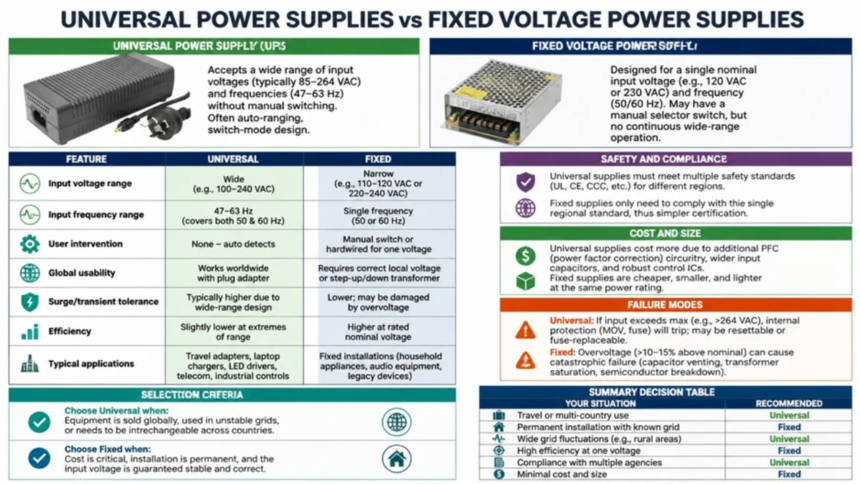
Choosing the right power supply for an electronic device is not always straightforward. With a wide range of switchmode options available, two common categories stand out: universal power supplies and fixed voltage power supplies. While both convert AC mains power to DC power, they serve different purposes and suit different applications. This article compares the two types, explains their pros and cons and offers practical guidance on selecting the correct unit for common devices such as CCTV cameras, LED lighting and routers.
What Is a Universal Power Supply?
A universal power supply, sometimes referred to as an adjustable power supply, is a switchmode power supply that allows the user to select the output voltage from a range of preset options. Typically, these units feature a dial or switch on the casing that permits adjustment between common voltages such as 3V, 4.5V, 5V, 6V, 7.5V, 9V and 12V. Some models also include interchangeable plug tips to fit different device connectors.
Universal supplies are designed to replace a lost or damaged adapter when the original specifications are unknown or when a single unit needs to power multiple devices at different times. They are a convenient option for households, workshops and technicians who want one adapter to cover several low-power applications.
What Is a Fixed Voltage Power Supply?
A fixed voltage power supply outputs a single, constant DC voltage. Examples include a 12V 2A switchmode plug pack or a 24V 3A power supply. These units are built to deliver a specific voltage and current rating and they cannot be adjusted by the user.
Fixed voltage supplies are typically used in applications where the voltage requirement is well defined and stable. This includes CCTV cameras, LED strip lighting, routers, monitors and many other electronic devices that have a specified input voltage printed on their label or in their manual. Because they are designed for a dedicated purpose, fixed voltage supplies are often more compact and may offer better performance and reliability for that specific voltage. Also see DC Power Supplies In Australia: Stock for CCTV, Networking And Electronics
Key Differences and Use Cases
| Feature | Universal Power Supply | Fixed Voltage Power Supply |
| Output voltage | Adjustable across a range | Fixed at one voltage |
| Current rating | Usually fixed at a single amp rating | Fixed at a single amp rating |
| Connectors | Often includes multiple plug tips | Single connector type |
| Typical use | Replacing unknown adapters, multi-device use | Dedicated devices with known requirements |
| Example applications | Older consumer electronics, small gadgets | CCTV cameras, LED lighting, routers |
Universal supplies are best suited for low-current devices where exact voltage is less critical, such as battery-powered toys, portable radios and older consumer electronics. Fixed voltage supplies are the correct choice for equipment that demands a precise voltage and consistent performance, such as security cameras, LED drivers and networking equipment.
Pros and Cons of Each Type
Universal Power Supply Pros
- One unit can replace several different adapters
- Useful when the original adapter’s voltage is unknown
- Often includes multiple plug sizes
- Convenient for testing and troubleshooting
Universal Power Supply Cons
- Wrong voltage selection can damage equipment
- Generally limited to lower current outputs
- May introduce voltage ripple or noise on sensitive devices
- Not ideal for high-power equipment
Fixed Voltage Power Supply Pros
- Delivers a stable, accurate output voltage
- Designed specifically for the device’s requirements
- Safer for sensitive electronics
- Available in higher wattage ratings
Fixed Voltage Power Supply Cons
- Requires correct unit for each device
- Not flexible if the device changes
- May need multiple units for different applications
How to Choose the Right Supply for Your Device
Selecting the correct power supply begins with identifying the device’s input requirements. Check the label on the device or the original adapter. Look for the DC output voltage (e.g. 12V) and the current draw in amps (e.g. 1A). The replacement supply must match the voltage exactly and provide at least the same current rating. A higher current rating is acceptable, but a lower one is not.
For fixed installations such as CCTV systems, LED lighting or network routers, a fixed voltage power supply is recommended. These devices run continuously and require a reliable, stable DC source. Using a universal supply increases the risk of accidental voltage mismatch and may not deliver the same level of regulation.
For occasional use with small consumer items where the voltage is uncertain, a universal supply offers flexibility. However, the user must set the voltage correctly before connecting the device. It is worth noting that many universal supplies are limited to 1A or less, so they are not suitable for high-drain equipment.
Reference should be made to Australian electrical standards in general terms: all mains-powered equipment sold in Australia must comply with relevant electrical safety requirements and users should ensure that any power supply is used in accordance with its intended purpose and ratings. See Australian Power Supply Standards: Complete Guide 2026 for more information
Examples by Device Type
- CCTV cameras: Fixed voltage 12V supply. Cameras often draw between 1A and 2A depending on features. A dedicated 12V supply ensures stable operation and reduces the risk of image flicker or damage.
- LED lighting: Fixed voltage 12V or 24V supply depending on the strip or fixture. Matching the voltage is essential to prevent dimming or overheating. Current should be selected based on the total wattage of the LEDs.
- Routers and modems: Fixed voltage 9V or 12V supply. These devices run continuously, so a reliable, regulated supply is important. Universal supplies may introduce noise that affects network performance. NBN modem power supplies.
Summary
The choice between a universal power supply and a fixed voltage power supply comes down to the application. Universal units offer flexibility and convenience for low-power consumer items, while fixed voltage supplies deliver precision and safety for devices that run continuously or require exact voltage. For CCTV cameras, LED lighting and routers, a fixed voltage switchmode supply is the recommended option. When in doubt, always match the voltage exactly and ensure the current rating is equal to or greater than what the device requires. A wide selection of both fixed and adjustable DC power supplies is available from Campad Electronics to suit various applications.
FAQ
Can I use a universal supply instead of fixed voltage?
Yes, but only if the voltage is set correctly and the current rating is sufficient. For sensitive or continuously operating devices, a fixed voltage supply is safer and more reliable. If you are unsure, consult the device manual or a qualified technician.
Which supply type is safer for sensitive electronics?
Fixed voltage power supplies are generally safer for sensitive electronics. They provide a consistent output and are designed for a specific application. Universal supplies carry a higher risk of incorrect voltage selection, which can damage circuitry.
Do universal power supplies cost more?
Universal power supplies are often priced similarly to fixed voltage units, but they may be less expensive than purchasing several dedicated adapters. However, for a single critical device, a fixed voltage supply offers better value in terms of reliability and safety.
Can a universal power supply damage my device if I set it to the wrong voltage?
Yes. Setting the output voltage higher than the device’s rated input can cause immediate damage to internal components, including capacitors, ICs and other sensitive circuitry. Setting it lower may prevent the device from operating correctly or cause erratic behavior. Always verify the device’s voltage requirement before connecting a universal supply.
What happens if I use a power supply with a higher current rating than my device needs?
Nothing harmful. A device only draws as much current as it requires. A supply rated at 2A can safely power a device that draws 1A, as long as the voltage matches exactly. The higher current rating simply means the supply has more capacity in reserve and will run cooler and more efficiently.
What happens if I use a power supply with a lower current rating than my device needs?
The supply will attempt to deliver more current than it is designed for, causing it to overheat, potentially shut down or fail permanently. The device may also operate intermittently or not at all. Always choose a supply with a current rating equal to or greater than the device’s draw.
Are universal power supplies suitable for outdoor or industrial use?
Generally, no. Most universal supplies are designed for indoor, low-power consumer electronics and lack the rugged enclosures, ingress protection (IP ratings) or thermal management required for outdoor or industrial environments. Fixed voltage supplies are available in weatherproof and industrial grades for such applications.
Do fixed voltage power supplies produce less electrical noise than universal ones?
Typically, yes. Fixed voltage supplies are often designed with tighter output regulation and lower ripple for a single voltage point, which is important for sensitive equipment like audio gear, medical devices or networking hardware. Universal supplies, due to their adjustable design, may have higher ripple or switching noise at certain voltage settings.
Can I replace a fixed voltage supply with a universal supply for a router or modem?
Technically yes, if you set the voltage exactly and the current rating is sufficient. However, routers and modems run continuously and a universal supply may introduce voltage fluctuations or noise that can affect signal stability. For critical networking equipment, a fixed voltage supply is strongly recommended.
How do I determine the correct current rating for my device if the original adapter is missing?
Check the device’s label or manual for the input power specification, usually listed in watts (W). Divide the wattage by the operating voltage to get the required current in amps. For example, a 12W device at 12V needs a 1A supply. If the current draw is unknown, choose a supply with a higher current rating to be safe, as long as the voltage matches.
Are universal power supplies allowed for commercial or safety-certified installations?
For permanent installations, such as security systems or building lighting, fixed voltage supplies that carry relevant safety certifications (e.g., RCM, SAA, UL) are required. Universal supplies are typically not certified for fixed wiring or continuous commercial use. Always check local electrical regulations before installing any power supply.
Can I use a 24V fixed supply on a 12V device?
No. Connecting a 24V supply to a 12V device will almost certainly destroy the device. Voltage must match exactly. Current rating can vary, but voltage cannot.
What is the typical lifespan of a universal supply compared to a fixed voltage supply?
Fixed voltage supplies, especially those designed for continuous operation (such as for CCTV or LED lighting), often have longer lifespans due to better thermal design and higher-quality components. Universal supplies are usually built for intermittent use and may degrade faster when run at full load for extended periods.
Do universal power supplies come with overload protection?
Many do, but protection features vary by brand and model. Some include short-circuit and overcurrent protection, while others do not. Fixed voltage supplies for commercial use typically include robust protection circuits. Always check the specifications before purchase.
Can I use a universal supply to test a device if I don’t know its voltage?
No. Guessing the voltage can damage the device. Instead, look for markings on the device itself, the original adapter or the user manual. If no information is available, consult the manufacturer or a qualified technician before applying power.